October 15, 2026
Nine Kinds of Villager
Farmhand, Smith, Mage, Priest, Cutpurse, Woodsman, Trader, Apothecary, Sellsword. Who turns up at your tavern, what they are good at, and what your town has to build to attract them.
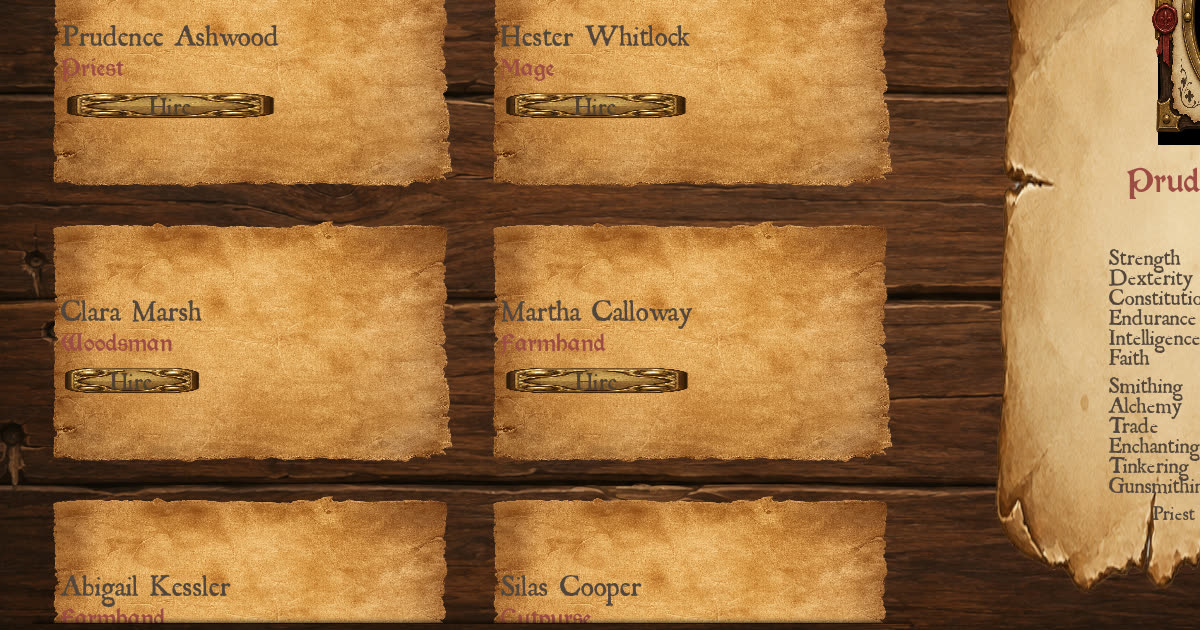
On Wednesday we wrote about villager stats. This is the post about who rolls them. The town's recruits are generated from nine archetypes, and each one is a small design in itself: a job title, a few lines of who they are, a stat lean, a set of likely traits, and a rule for when they start showing up at the tavern.
The roster
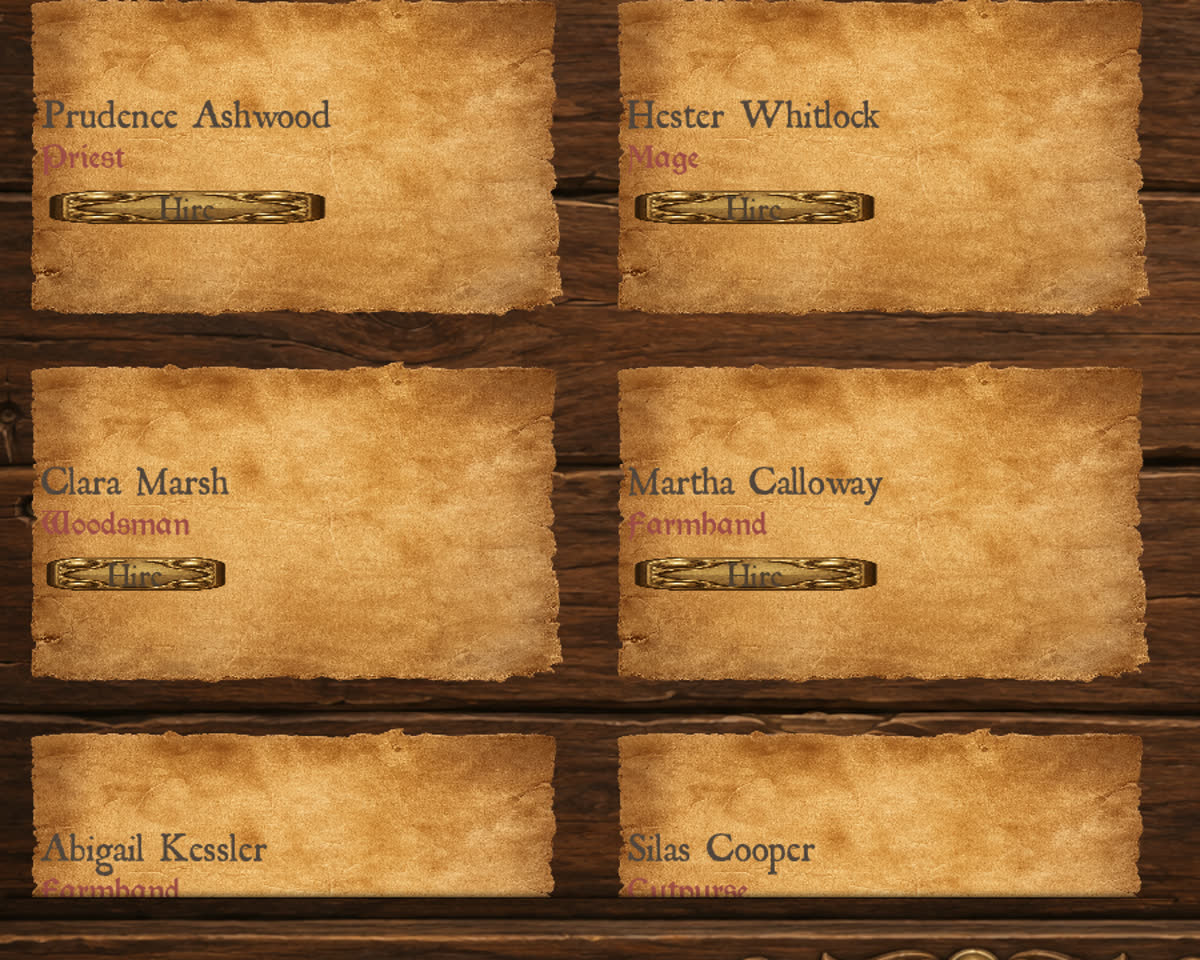
Every archetype exists as data for both a male and a female body, so the generator can produce eighteen kinds of person before traits and names come into it. A few of them, in the words of the design sheet:
- Farmhand. Works the fields outside the palisade. Strong back, slow to panic. The baseline hunter: best Constitution and Endurance of the starting pool.
- Smith. Arms like fence posts, burns up both forearms. Trusts iron over prayer. A melee bruiser and the natural head of the forge.
- Mage. Studied under someone who is no longer spoken of. Reads by candle, sleeps badly. A glass cannon with the highest Intelligence and the weakest body.
- Priest. Came west with a bible and a lantern, and has buried more of this town than he has married. Support: heals and wards scale on Faith.
- Cutpurse. Left the last town in a hurry. Quick fingers, quicker excuses. A skirmisher, fragile and the fastest thing on the roster.
- Woodsman. Runs traplines past where the road ends, and has seen things in the trees. The ranged specialist, at home with a flintlock or crossbow.
- Trader. Arrived with two wagons and left with one. Counts everything twice. The weakest fighter in town and the best reason to keep one at home.
- Apothecary. Fingers stained green to the knuckle. Sells tonics out the front and other things out the back. A utility caster who throws consumables well.
- Sellsword. Mustered out with a limp and a pension that never came. The frontline body, strong and durable, competent at range.
Nobody is strictly better
The stat rolls are budgeted. Every archetype lands around the same expected total across its twelve stats, so a Sellsword is not a better Farmhand, just a different one. Primary stats roll three to five, secondaries two to four, and weak stats one to two. The interesting consequence is that archetypes only bias the roll. A lucky Farmhand who rolls a five in Smithing is a perfectly legitimate head blacksmith, and you will find yourself keeping villagers for the numbers they happened to get rather than the job on their card.
Traits sit on top of that. Some come with the job: every Mage has studied the arcane, every Priest is ordained, every Cutpurse has light fingers, every Sellsword is a veteran. Others roll: Hardy, Brawny, Tireless, Devout, Steady Hands, a fondness for drink. And each villager gets a life beyond the job, married or a parent or a retired soldier, resolved to husband or wife, father or mother, by who they are. Those identities are already feeding the contract writing, because a story about a missing child lands differently when the recruit reading the board is somebody's mother.
Who shows up, and when
Recruits appear at the tavern in generations, and what your town has built decides who is in the pool. Farmhands, Woodsmen and Sellswords are always there. A Smith needs a blacksmith's forge to exist. A Mage needs the guild, a Priest the church, a Trader the shop, an Apothecary either the shop or the guild. The Cutpurse arrives when you have built an inn, or when the town's reputation has slipped far enough that people like that start turning up on their own.
Named characters cut the line. They arrive ahead of the generated pool, do not count against the tavern's capacity, and take the seat in town that belongs to them if it is empty. Two exist so far: a master of the guild and a father of the church, each with a hidden name and a threshold at which they walk out on a town whose morality has gone the wrong way for them. The generated Mages and Priests keep coming while those two hold their seats, and one of them steps up when a named head leaves.
What's next
Two archetypes are placeholders in the recruit rules, the Trader and the Smith, until the shop and forge buildings settle. The next content on this side of the game is the contracts themselves, written per story arc rather than per creature, and the conversations with the two named characters, which is where their true names will finally come out.