October 6, 2026
No Clue Convicts Alone
How deduction works in The Last Fairytale: four kinds of evidence, a roster of suspects, a rule that no single clue names the creature, and a vote you had better get right.
For most of this year our internal playtests had a problem we could not tune away: everyone knew it was a werewolf. There was only one creature to roll, every piece of evidence was written in werewolf vocabulary, and each clue was a decisive answer. You found a paw print and you were done. That is a scavenger hunt, not an investigation. This post is about the design rule that replaced it, and about the parts of it that are still unfinished.
Four ways the forest talks
Every creature leaves evidence in the same four channels, and each channel has its own tool.
Tracks are read with the Looking Glass: paw prints, claw marks, bare human footprints. Residue is read with the alchemy kit, which turns a sample into blood, rot or raw magic. Sound is caught with the listening horn: a howl, a whisper, a cry for help that is not human. And omens are read from the world itself, starting with the moon, with more signs in the sky and on the ground planned.
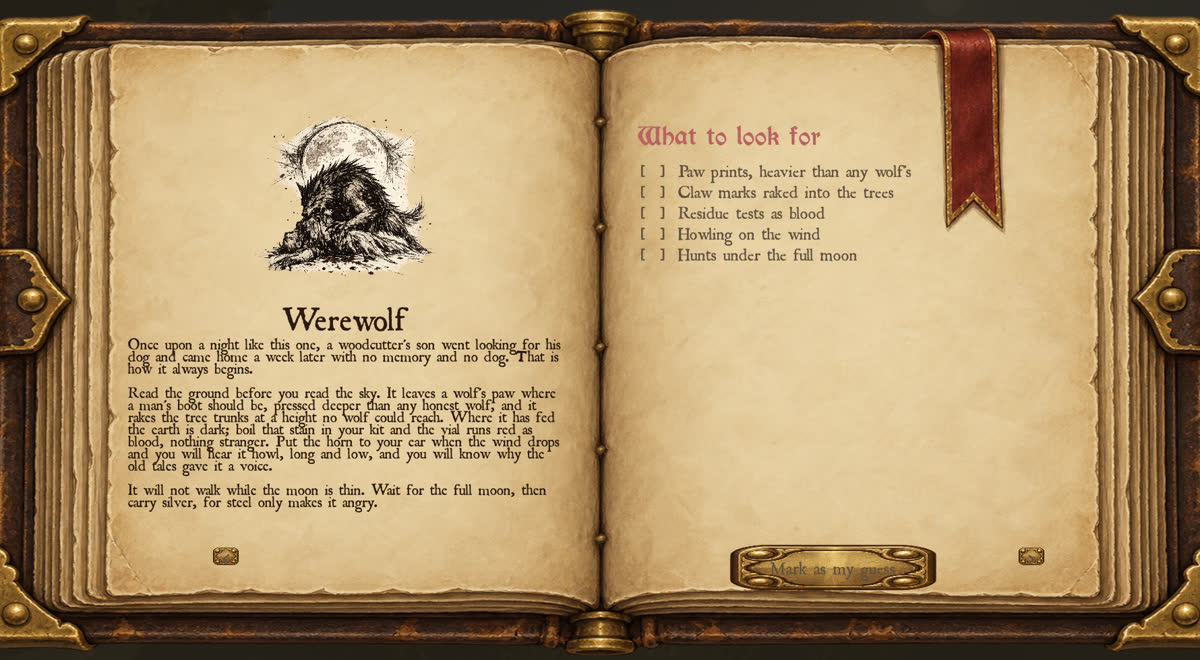
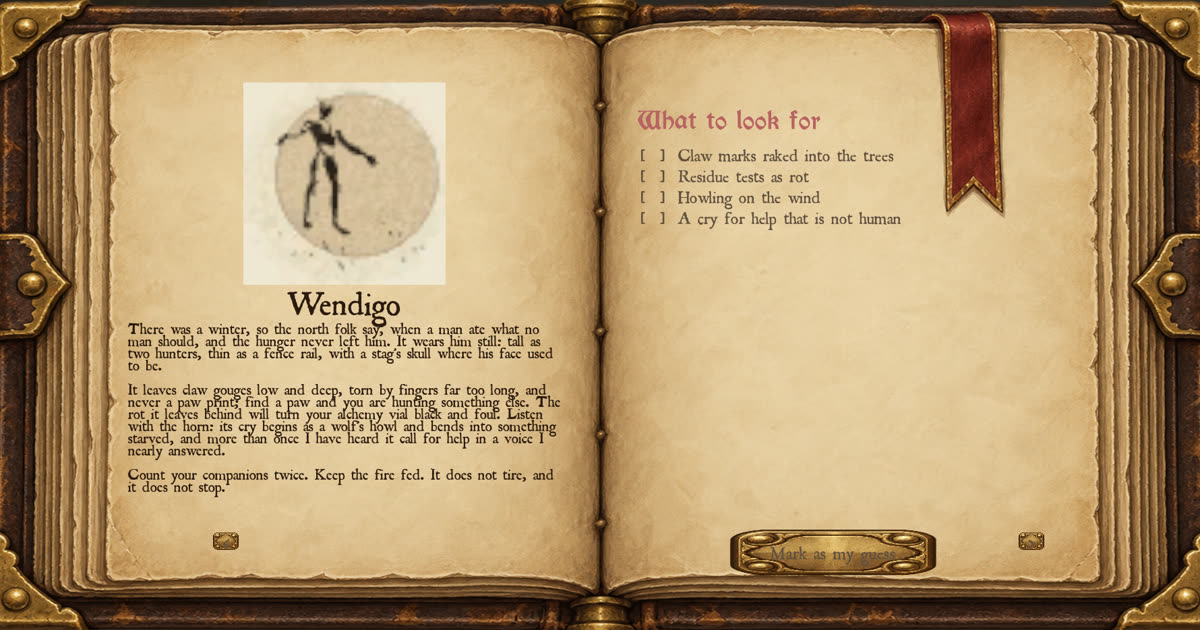
The notebook keeps a page for every suspect, with the journal's account of it and a checklist of what to look for. Four creatures have pages today: werewolf, Wendigo, Skinwalker and witch, and the design has room for six. A contract never names the creature. Every job you take carries a hidden weighted roll across the roster, so any contract can be anything, and the only way to find out is to walk into the woods and read.
The rule
The rule that fixed the werewolf problem is simple to state: no single clue may identify a creature. Every value in every channel has to belong to more than one suspect, so the first clue you find narrows the roster rather than closing it, and you need a second, different clue to be sure.
That is why the werewolf leaves claw marks as well as paw prints, why the Wendigo and the Skinwalker both cry for help in a stolen voice, and why the witch walks barefoot like the Skinwalker does. Under the rule, a good hunt has a shape. The first clue gives you two suspects. You argue at the campfire about which channel would split them. You go and find it, or you do not, and you gamble.
How much evidence a hunt gives you is tied to threat. The more the creature's attention is on you, the more it leaves behind, so a party that plays it safe may end the investigation with two suspects and a choice, while a party that pushes deeper gets the clue that settles it, at a price. Difficulty comes from that pacing, not from making clues rare.
The vote
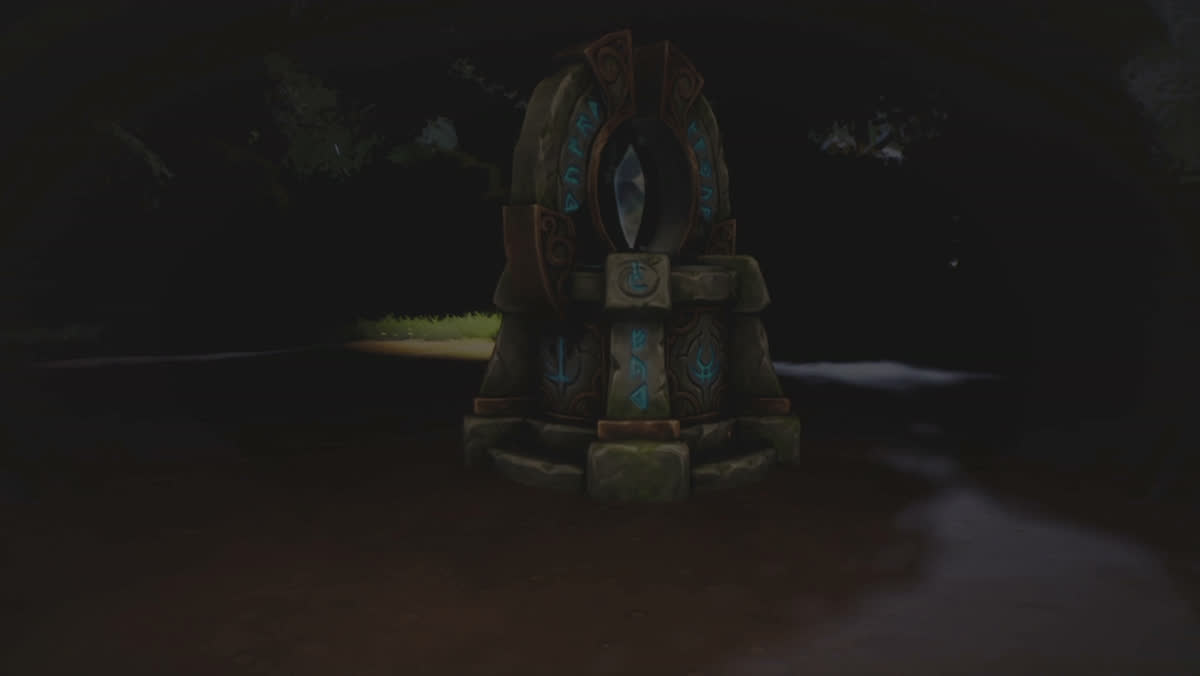
When you think you know, you mark the creature in your notebook and the party locks its guess at the guessing stone. That vote is the hinge of the whole hunt, because there are three ways a hunt can begin and the vote decides which one you get.
Guess right and you get the fair fight: the creature at its normal strength, and you have had time to bring the weapon it is weak to. Guess wrong and the creature comes for you angrier and harder than it should be, while you stand there holding a silver blade against something that shrugs silver off. And if you dither long enough that threat boils over before any vote is locked, the hunt starts anyway, on the creature's terms. That version is built for running: the creature is easier to lose, but it is still stronger than the fair fight, because recklessness should cost something too. A correct call also pays a bonus on the contract, as does simply witnessing enough different kinds of evidence, so careful investigation is rewarded even when the fight goes badly.
What is still broken
Honesty is the point of a devlog, so here is the part that does not work yet. The rule was designed for six suspects, where every clue value can be shared by exactly two. Today the roster is four, and with four, some clues still convict on their own. Rot in the vial can only be the Wendigo. A paw print can only be the werewolf. Our own design document flags this in bold, and it is the next thing on the investigation list.
Two fixes are on the table. One is to let each creature express two values per channel, the way the werewolf already leaves both paws and claws, so that every value is shared again. The other is to accept that alchemy is the deliberate exception: the kit is a consumable, so paying a resource for certainty is a fair trade rather than a flaw. We have not made that call yet. It is a question about what each creature is, not just a balance number, and it deserves a playtest.
What's next
More suspects in the pool, which fixes most of the arithmetic on its own. Degraded evidence, like a partial print that could be paw or claw, to widen the ambiguity without new systems. And a deduction aid in the notebook that marks each suspect consistent or ruled out as clues come in, so the argument at the campfire is about what to do next, not about what you have already found.