November 10, 2026
The First Villagers
The last catch-up post: the May sprint that turned villagers from names into people with traits, roles and identities, and set up everything the September stats system was built on.
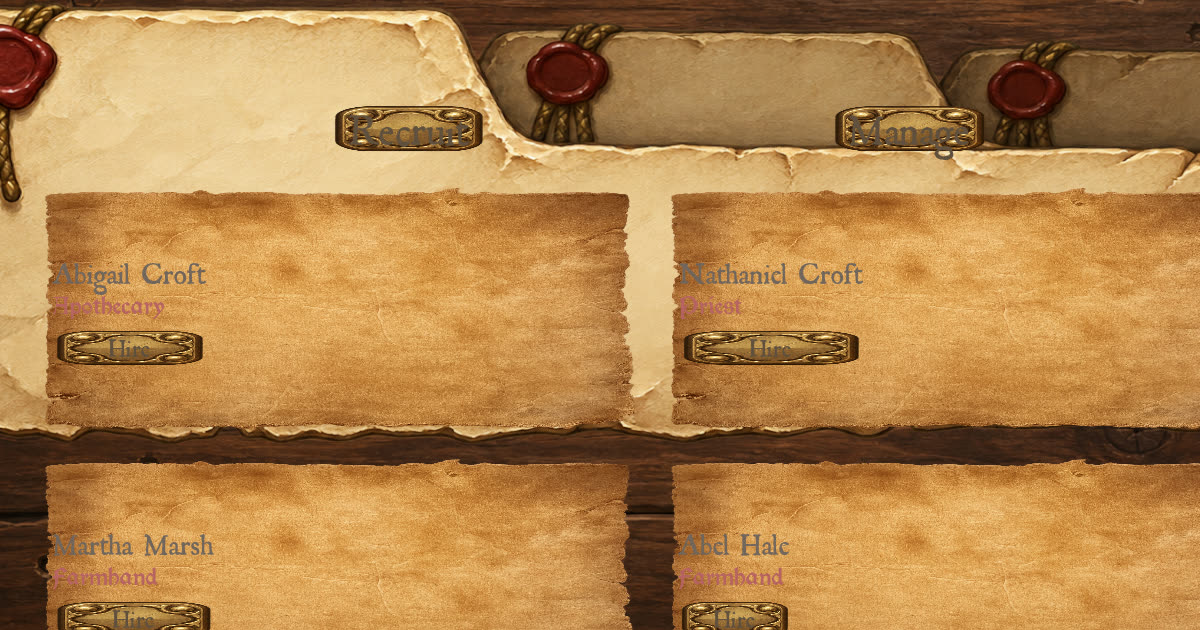
This is the last of the catch-up posts, and it closes a loop. In October we wrote about villager stats and the nine archetypes. Both of those were built on a sprint from May that we never wrote up, when villagers first stopped being names in a list and started being people.
Rolling a person
Before May, a villager was a name and a body. The May sprint added a generator. Each archetype carries a pool of weighted role tags, and a new villager rolls one as their primary role: this one is a farmer, that one a townsman. Then a second set of identity tags is rolled independently, each with its own chance: married, a parent, a retired soldier. Those identities are read by the contract board, so a posting can look for a particular kind of person, and by the dialogue, so a story about a lost child lands on somebody's mother.
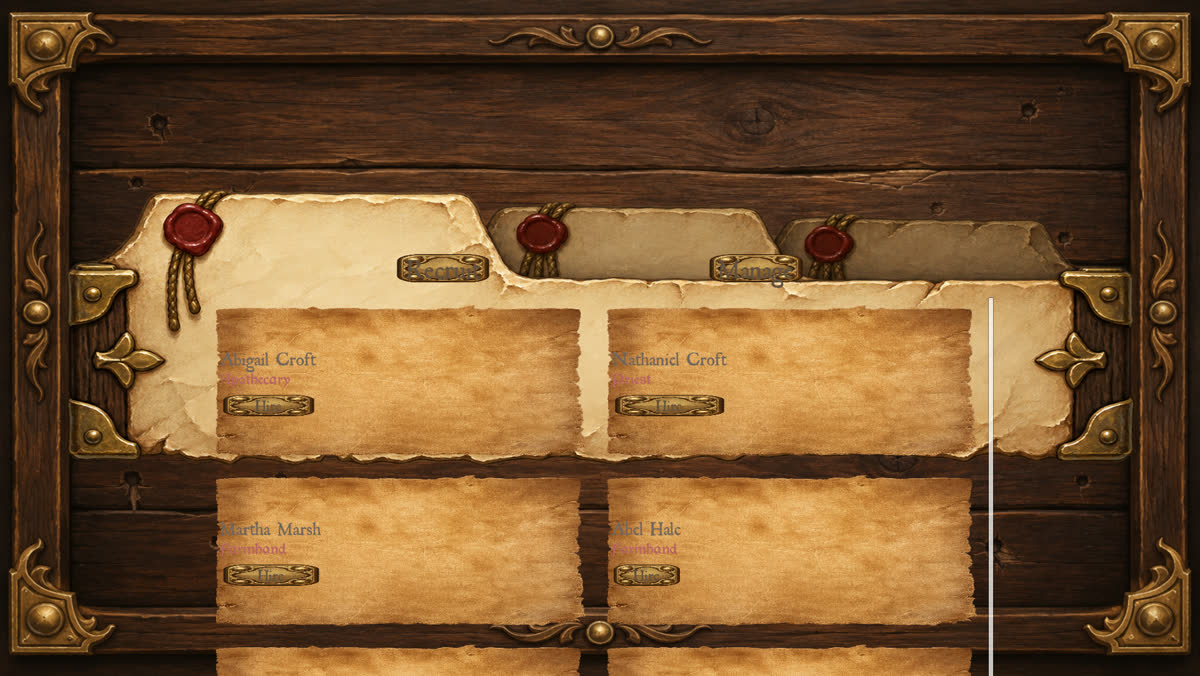
Traits came in the same sprint, and the design of a trait has barely changed since. A trait has a name and a line of flavour for the roster. It can grant a role tag, and some roles are single-occupancy, so there is only ever one town blacksmith by trait even if several villagers could do the job. It carries flat stat bonuses on top of the archetype's roll. And it can carry contract unlock tags, so having a certain kind of person in town opens certain kinds of work on the board. Some traits every archetype gets; others roll with a weight, and a few are deliberately rare.
What the stats were, before they were stats
The stat block that sprint gave villagers was a set of floating-point numbers: health, stamina, walk speed, a sprint bonus, crafting skill, strength, magic, accuracy, dexterity. It worked, and it was muddled. Accuracy and dexterity overlapped. Magic did not say whether it meant the guild's kind or the church's. Nothing was on a scale a player could read at a glance.
The September stats sprint replaced that block with twelve integers from one to ten, six for the body and six for the jobs, and it could do so in a few days because the May sprint had already put the roll, the traits and the identities in the right places. The trait bonuses simply changed what they added to. The save file changed shape, and old saves load with every stat at one, which we decided was acceptable for an internal build.
The rest of the sprint
The same commit touched more than villagers. It reworked how the game instance holds the town, which is where the roster, the recruits and the buildings live between hunts. It added the town's tag vocabulary, sixty-odd tags for roles and buildings that everything since has been written against. And it made the settings screen aware of the new data.
What's next
With this post the devlog has caught up with the build, from the April update to the end of September. From here the posts track the current sprints: the attack library and the reaction system that followed it, the new hunt AI, the crossbow, the hunter's outfit, and the test map all of it is tuned in.