November 19, 2026
The Repeating Crossbow
Nine stakes in a drum, a lever to cock it, and a Blender script that builds the whole weapon from scratch. How the hunter's crossbow went from a blocky download to a rigged, textured gun in the build.
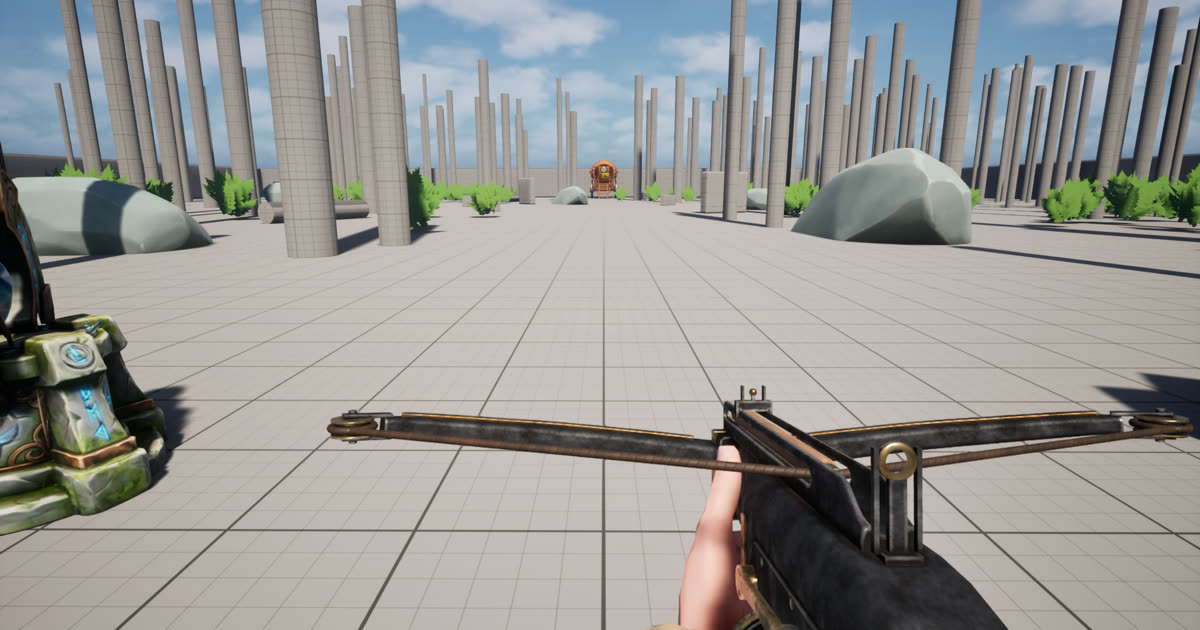
Every monster hunter needs a crossbow, and ours needed a particular one: the under-slung drum, the wooden stakes, the brass and iron of a film prop rather than a medieval siege piece. We could not buy that. So we built it, and we built it in a way that lets us rebuild it whenever the design changes.
A weapon as a script
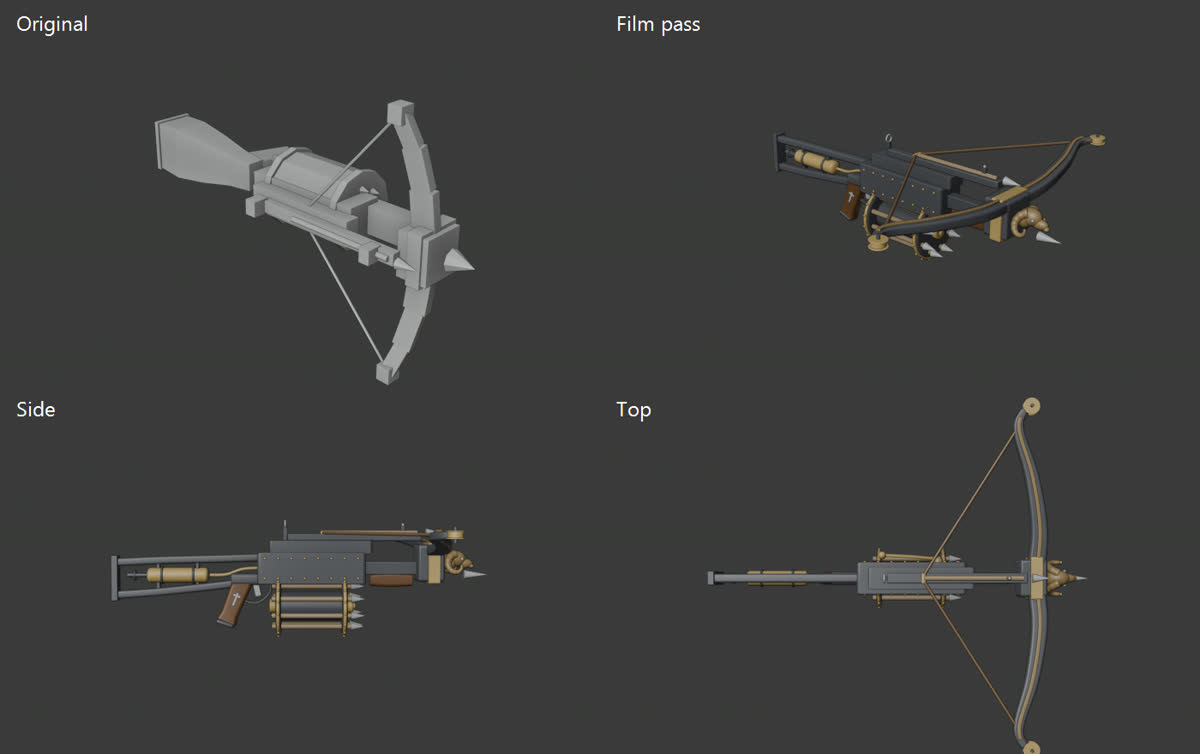
The starting point was a blocky low-poly download that imported lying on its side. Rather than sculpt on top of it, we wrote a Blender script that constructs the whole weapon from parameters: the forged receiver, the lock plates and clamps, the raked wooden grip with its steel crosses, the recurve arms with pulleys and a bronze rib, the leather strings, the brass cocking lever, working iron sights aligned on one line, a wrist strap, and the cage drum with its dished caps and pierced band. Run the script and out comes the model. Change a number and run it again.
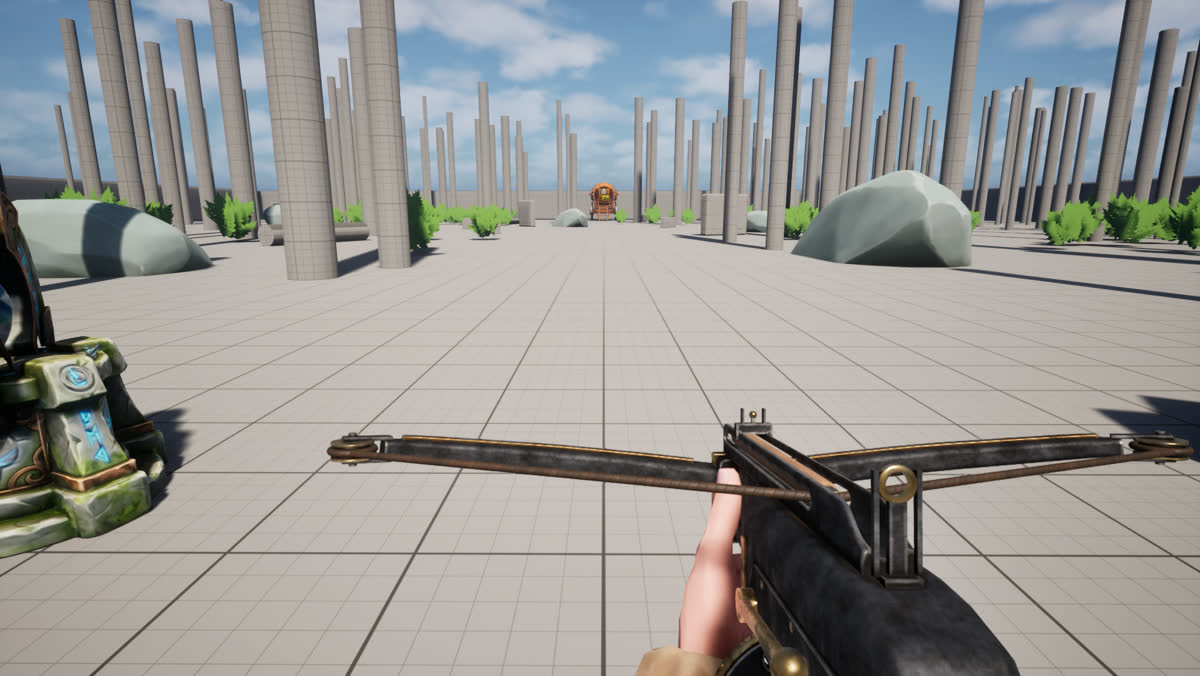
That approach paid for itself in the first day of feedback. No ram's head on the front, no bayonet; a slimmer mount with a brass cross. The stakes must be one solid piece of wood with a sharpened pencil point, not a metal tip. The loaded stake sits in a channel with a real clearance gap, and nothing may pass through anything else, ever, including the front sight, which became a bridge over the stake. Triggers curl forward and pull back. Each of those was a change to a few lines and a re-run, and every version was checked by a strict clearance audit that reports any two parts touching, at rest and at quarter-frames through the animations. The final count is zero, across four hundred and forty-one pairs of parts.
The rig came from a second script: twenty-six bones, a bind pose in the fired state, and animations for cocked idle, fired idle, fire and cock. The drum holds eight stakes with a ninth on top, so the first load is nine shots and every reload after is eight. Each stake in the drum is its own mesh that hides as it is spent. A third script bakes the textures, four thousand pixels on the body, with the palettes sampled from the flintlock's own textures so the two weapons sit together, and a dark cool iron with golden brass chosen after a round of variants.
Into the game
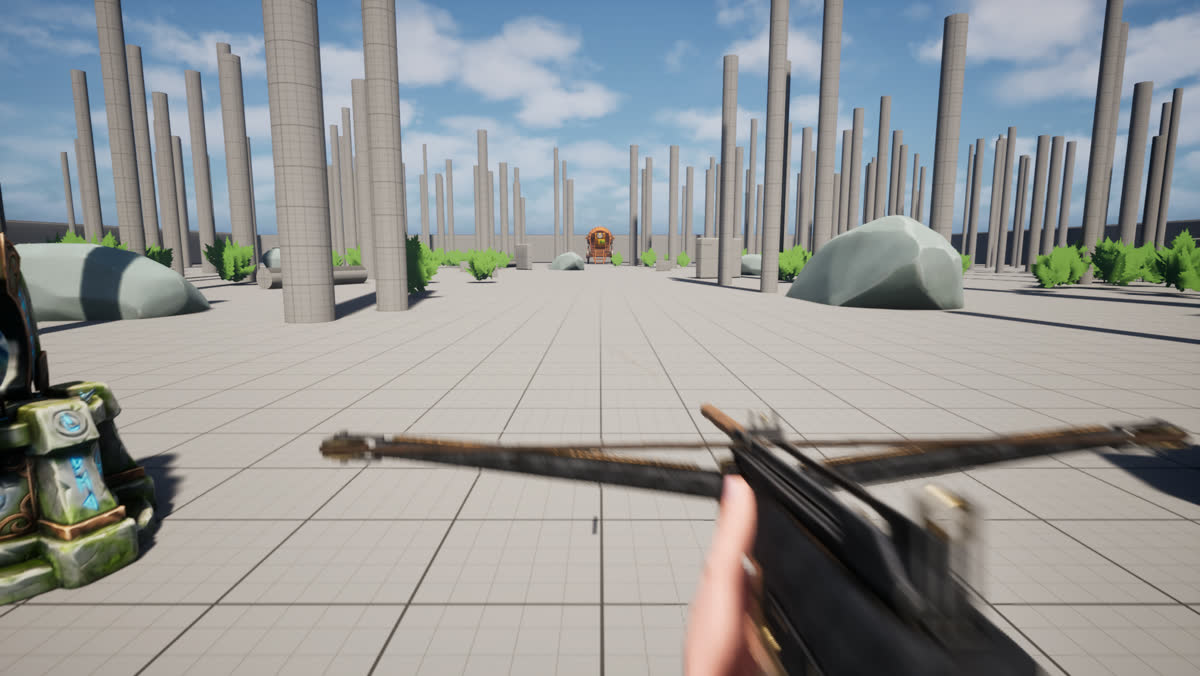
Importing it took a day of its own, including the discovery that a Blender export can look perfectly right in the editor and still turn every attached mesh invisible in play, because of how it writes scale into the file. The rules for that are written down now. In the build the crossbow is a two-handed weapon: the torch goes away while it is out, the left hand is placed on the foregrip by inverse kinematics so it stays there through every pose, and the hold is a rifle stance with the butt against the shoulder and the sights on the eye line. The first-person framing was approved in a single playtest note: the crossbow looks perfect.
Reload dropped the drum as a real physics object, and we tested that it lands on the ground from nine positions, because a drum that falls through the floor is the kind of thing that ruins a moment. Reload also works at any time now, not only when the drum is empty: a partial drum drops and a full one goes in.
Ammunition as preparation
The stakes come in wood, silver and iron, and the design decision behind them matters more than the models. Preparation is part of the game, so there is no switching ammunition mid-fight. You choose what to bring, and what you bring is unlimited for that hunt; the limits are stamina per shot and the time a reload takes. Base damage comes from the weapon, damage type from the stake. That keeps ammunition as pure data, so a new stake type is a new entry and a new material, not new code, and it lines up with how creatures already resist and fear different materials.
What's next
The pistol is next in line for the same treatment, and it is behind: a two-hand support when the off hand is empty, a proper place for the torch during a reload, and a down-the-barrel aim. Beyond that, modular receivers and bows for quality tiers, once the crossbow has been through more hands than ours.