October 14, 2026
Villagers Get Stats and Jobs
Every townsperson now has twelve stats, a level, and a job they can be put in charge of. When you hunt, you hunt as one of them, and what they are good at is what you are good at.
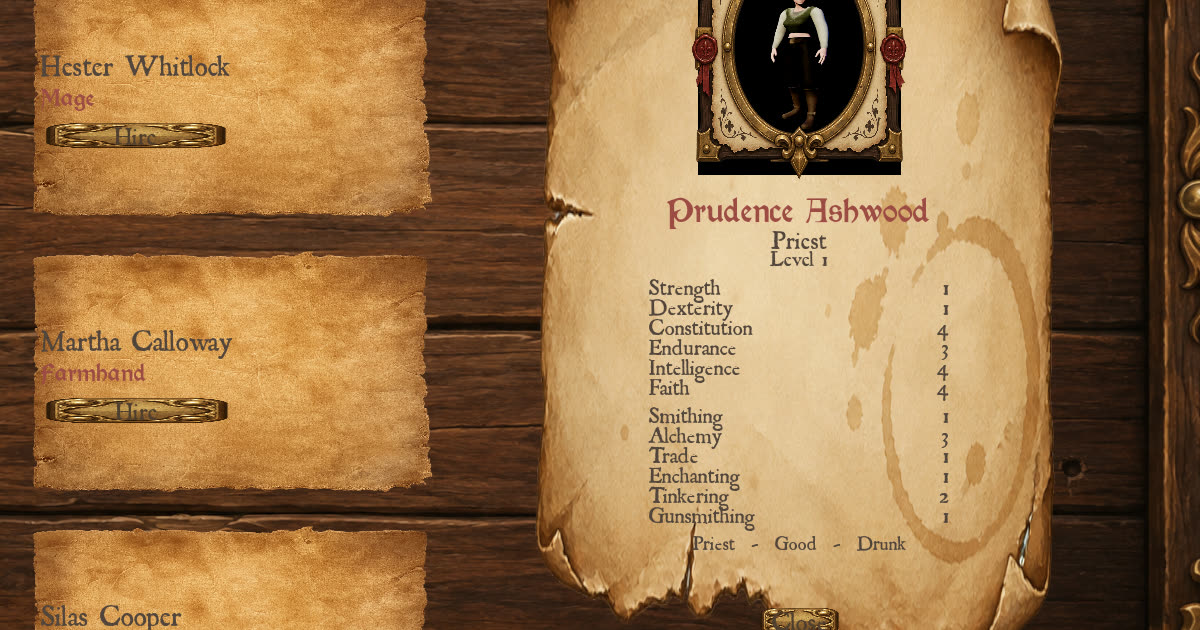
The town in The Last Fairytale is not a menu. It is a roster of people, and when you go into the forest you go as one of them. That idea has been in the design since the start, but until this sprint the villagers were mostly names with a handful of vague numbers behind them. Now they are characters with sheets, and the sheet matters.
Twelve stats, one to ten
Every villager has six core stats and six job stats, each an integer from one to ten. The core six are the ones a hunter feels in the field. Strength drives melee damage. Dexterity drives crossbows and guns. Constitution sets health and Endurance sets stamina. Intelligence powers arcane damage, curses and alchemy. Faith powers healing, wards and blessings.
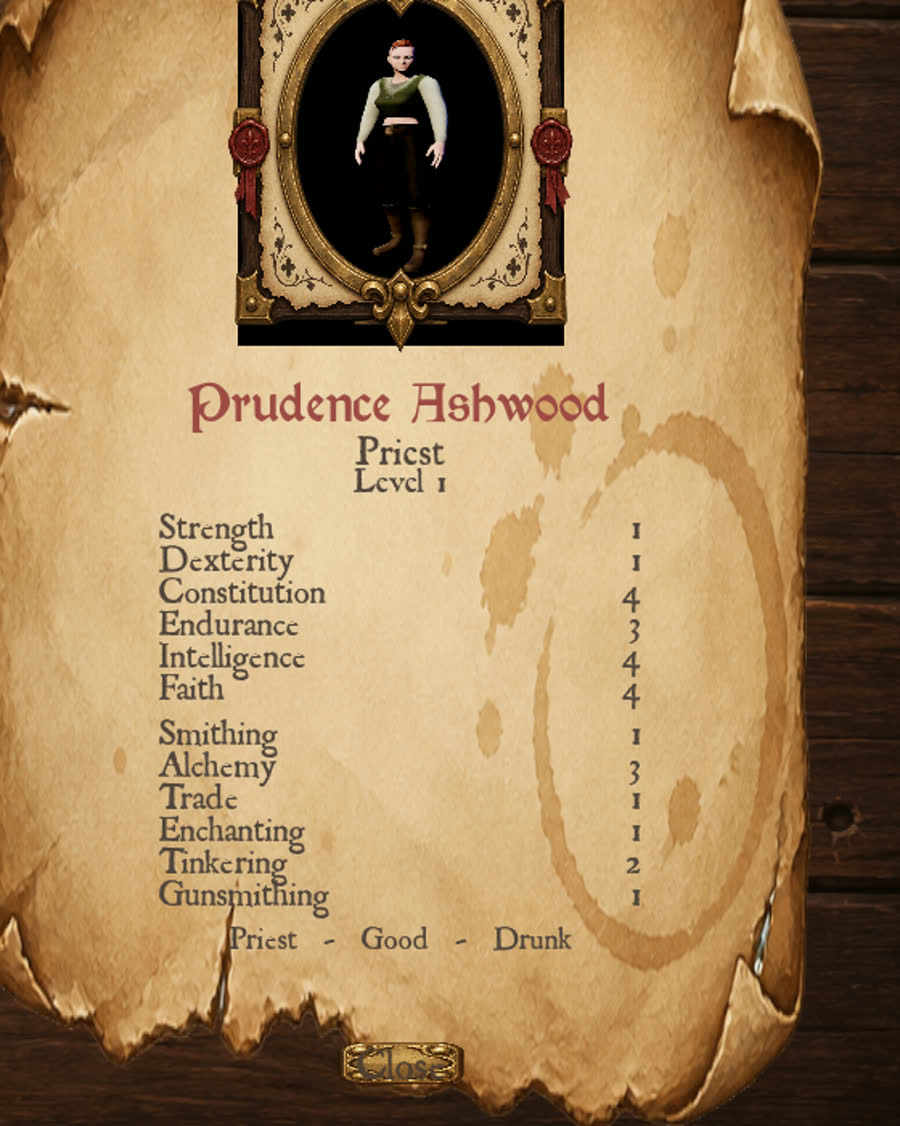
The job six are what a villager is worth to the town: Smithing, Alchemy, Trade, Enchanting, Tinkering and Gunsmithing. A generated villager rolls low in most of them and higher in what their background suggests. A farmer rolls Strength. A thief rolls Dexterity. A smith rolls Smithing and Strength together. A priest rolls Faith. Named characters arrive with fixed sheets, and some of them arrive very good at one thing.
Stats grow on level up, and you spend the points yourself. We chose that over learn-by-use on purpose. The goal is attachment: a villager you have shaped over ten hunts is a villager you will not want to lose, and in this game villagers can be lost.
Heads of the town
Each job stat has one seat in town, and you decide who sits in it. Put your best smith in charge of the forge and every weapon crafted there rolls better, with the smith's name on it. Put a sharp trader in the market and prices move in your favour, cheaper to buy and better to sell. The church seat is the exception, because it reads the head's Faith rather than a job stat, and named characters who belong in a seat will take it automatically when they join, if it is empty.
Crafting now produces items of varying quality, and the head's stat is the thumb on the scale. That makes the town management screen a real decision rather than a list, and it makes losing your head alchemist in the forest hurt in a way a health bar never could.
You are the villager
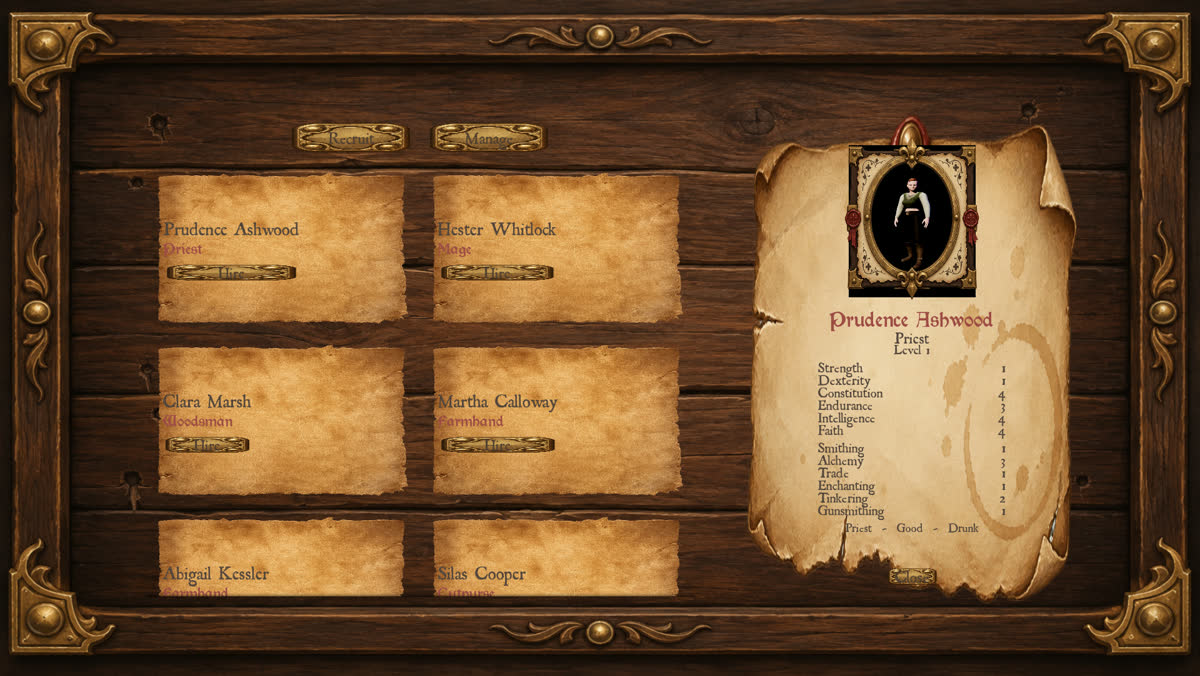
When you hunt, you play a villager, and the hunter carries that villager's stats. We have described this before as the State of Decay model, and that is still the shortest way to say it. Strength on the sheet is your melee damage. Faith on the sheet is how well your healing works. Swap to a different villager for the next contract and you are a different hunter, with different strengths, which is the point of keeping a roster instead of a single character.
Every villager is playable, including the named ones. If a named villager dies or leaves, the story changes with them.
What the wagon brings home
This sprint also settled how loot works, and the rules are simple and a little cruel. Resources and blueprints go into the wagon as counters and are banked to the town only when you extract. Consumables are items: they go into your hands, or onto the floor if your hands are full. Anything not in the wagon at the end of a hunt is lost. Dead hunters drop a body their friends can loot. A slain creature leaves a carcass you must actually search. And a contract only pays if you complete it and bring it home; a wipe is not a completion.
We also fixed a quiet bug while wiring this up: blueprints discovered on a run were being collected and then never actually granted. Every blueprint anyone found before this sprint was thrown away at extraction. That is fixed, and it is the kind of thing a proper test rig catches, which is why we built one this week too.
What's next
The screens for spending points and seating heads are the first pass, and the villager preview in the tavern is a mannequin on an off-screen stage that we will keep dressing. Revival kits exist and work, but they wait on the loot loop feeling right before they go into the chest tables. And the archetypes themselves, the nine kinds of villager that decide who rolls what, get their own post on Thursday.